
The Bizarro Rules of Interpretation

Blog Superhero 05I’m very much a “dot-my-i’s-and-cross-my-t’s” kind of person, and that’s been an extremely useful tool in harnessing the anal retentive powers that make me the HTS Nerd.

But I admit – this was not always the case. Before I received that fateful paper-cut from a radioactive HTSUS and became a classification superhero, I often allowed myself to fall victim to those Classification Rules Whose Names Should Never Be Spoken. You know the ones – though unwritten, they are perhaps the most widely used rules in the industry.

Although they seem logical to most, these nefarious rules have the uncanny ability to cause major compliance problems and should never, ever be used under any circumstance. They are often used by inexperienced classifiers who simply don’t know better. But be warned, my faithful HTS Cadets… Ignorantia juris non excusat or simply, ignorance of the law excuses not.

For your safety, here are the Bizarro Rules of Interpretation (BRI) to be avoided at all costs:

BRI 1: 

If you wish to obtain a more favorable duty rate, simply change the name of the product you are importing.

This Bizarro rule is usually pushed onto the unsuspecting or inexperienced classifier by an aggressive sales or marketing department looking to find a way to cut costs on their import. Changing the name of a product doesn’t change either its essential character or what is actually is. The danger in attempting to use this BRI is that it goes beyond simple negligence into the realm of blatant fraud, as it is a deliberate attempt to avoid the proper payment of duty to CBP.

BRI 2a: 

Whenever a commodity is potentially classifiable within two or more headings, the tariff classification with the highest duty rate applies.

I hate to admit this, but I often fell prey to this concept in my early years when I was but a naive HTS cadet. Many importers mistakenly believe that by paying more duty that they will gain compliance points with CBP, but always remember – a wrong classification is a wrong classification, no matter the duty rate.


BRI 2b: 

Whenever a commodity is potentially classifiable within two or more headings, the tariff classification with the lowest duty rate applies.

The inverse to BRI 2a, this rule is most frequently used by importers who are naturally inclined to look for the lowest duty rate possible. The rate of duty should never be a consideration when trying to determine the correct classification of a product, and so experienced classifiers have learned to ignore the duty rate so as not to cloud the correct application of the GRIs and reasonable care to the classification process.


BRI 3a: 

If a classification for similar product exists within an HTS database, the importer’s ERP (Enterprise Resource Planning) system should always assign the same HTS code.

Although this superficially appears to be a reasonable solution, it relies on the erroneous assumption that the classification process is completely linear. It ignores the fact that even minor differences between products can result in completely different classifications. While most automated systems can certainly assist, they should only be used as a starting point, as the classification process is always subject to some level of interpretation that automation cannot provide.


BRI 3b: 

A classification will always be considered correct if it is never challenged by Customs and is used over a long period of time. Also known as the “We’ve always done it this way” rule.

Didn’t your mother ever teach you that two wrongs don’t make a right? Just because CBP has not challenged your classification, it doesn’t mean it is correct. It also doesn’t mean that CBP is not already aware of your incorrect classification as a larger case for non-compliance is being built.


BRI 3c: 

The wisdom of an importer’s broker should never be questioned when it comes to assigning classification to a product. Also known as the “The Supplier Made Me Do It” rule.

Even when a classification is assigned by your broker, the law holds the importer responsible for exercising reasonable care in both assigning classification and your broker management. The importer should always monitor the accuracy of the broker’s work, even if there is a documented classification process in place.


BRI 4: 

Whenever a commodity is subject to two or more headings, write all potential headings on slips of paper. Tape the slips of paper to a wall. Load a spitball into a straw and blow toward the slips of paper. The one to which the spitball sticks will be the correct classification. Also known as the Dartboard Rule or the Russian Roulette Rule.

Ready, aim, fire… the law of averages tell us you’re bound to get it right at least some of the time. But some of the time is by no means a demonstration of compliance, because just like a real life game of Russian Roulette, getting the wrong number can bring serious consequences. 


BRI 5a/b: 

CBP is not concerned about the accuracy of a complete 10-digit classification. It’s enough to at least classify in the correct four-digit heading (BRI 5a) or six digit subheading (BRI 5b).

Pardon the language of the HTS Nerd, but that is sheer poppycock! There is a logic and reasoning behind the government’s 10-digit system. Although classification to the eight-digit level will ensure the proper duty rate, statistical reporting requirements are determined at the ten-digit level. Although the distinction may seem trivial to most, it isn’t to regulators.


BRI 6: 

Whenever two individuals disagree over an HTS classification, the one with the biggest ego wins. If a bigger ego cannot be determined, other factors which may be considered are (in order of preference) the loudest voice, the higher ranking, or the greatest financial investment.

Need more be said?

Make no mistake, my HTS Cadets… the Bizarro Rules of Interpretation have no place when considering the real General Rules of Interpretation. Each of the Bizarro Rules of Interpretation carry their own risks that ultimately result in bad classifications when they stray from the actual GRIs. Simply stick to legal guidelines provided by the GRIs – they will not steer you wrong.

But in the event that you find yourself stuck with a particularly difficult classification, reach out to the HTS Nerd or other classification professional(s) for guidance before you turn to the BRIs and send yourself down a risky path.

 

The HTS Nerd vs. The Ruling Jumper (#HTSNerdAdventures)

HTS Nerd - Superhero 08International travel is not always about seeing the sites or trying the local cuisine, especially for a classification superhero. Sometimes, a nefarious foe will rear its head and you’ll find yourself battling for the mind of an HTS cadet.


I began the HTS Boot Camp with my new cadets in pretty much the same manner I usually do – by going back to the very basics. I have to make sure that my students have a good working knowledge of the most basic HTS fundamentals. We go over what it is, how it was developed, the structure of the HTSUS, and then start an intensive deep dive into the General Rules of Interpretation.

As my class of global HTS cadets discussed the resources available to help in determining a classification, one cadet said, “I just go to CROSS and use the part name to look for a ruling. I go with the first one I find at the top of the list.”

Although in the guise of this new cadet, I immediately recognized my old foe – the Ruling Jumper. As one of the 7 Deadly Classification Sins, the Ruling Jumper is a spirit that searches out for desperate cadet classifiers who are most susceptible to possession, usually when they find themselves struggling with a particularly difficult determination. It’s in that moment of frustration the Ruling Jumper can get in. He becomes that quiet voice in your mind whispering, “Just go to CROSS… just go to CROOOOOSSSSSSSS…” Before you know it, you’re disregarding all of your training and instead quickly scanning for the first ruling that might have some bearing.

Preying on a cadet’s eagerness to get a hard product classification out of the way and move on to the next, the Ruling Jumper guides the cadet’s fingers to the keyboard and types the most basic part name possible in CROSS to get the most results at once. Which is rather irrelevant because the Ruling Jumper just goes to the first listing that pops up and uses that HTS.

This isn’t my only time I’ve faced off against the Ruling Jumper. I admit – before that fateful paper cut from a radioactive HTSUS that transformed me into a classification superhero, I once fell prey to the Ruling Jumper. Fortunately, I’ve developed a tool that always weakens his hold – education. I know if I successfully educate this young cadet to sharpen his classification skills, the Ruling Jumper no longer has a foothold, and is forced to flee in search of a new host.

The list of reasons one should not jump to the rulings in CROSS are numerous, so let me share the top 3:

Number 1: They do not provide a complete picture.

The requesting company may not have included all of the details… perhaps even leaving something out intentionally in order to obtain a more favorable ruling.

In comparing someone else’s ruling to your product, you often have to make assumptions. There may be additional details that the CBP commodity specialist may not have included, so always keep in mind that the absence of detail in a binding ruling does not mean the detail does not exist.

Number 2: Rulings often change. 

Upon further review, Customs may re-determine their classification in a ruling, usually in the form of an HQ ruling. And unless you are the requesting party, you won’t receive direct notification of an update.

Additionally, if you are not frequently following up on every ruling that you reference in your classification’s reasonable care documentation, chances are that at some point you’ll miss an update.

Number 3: Rulings themselves may contain errors.

Believe it or not, you may come across a ruling in CROSS that contains some kind of error.

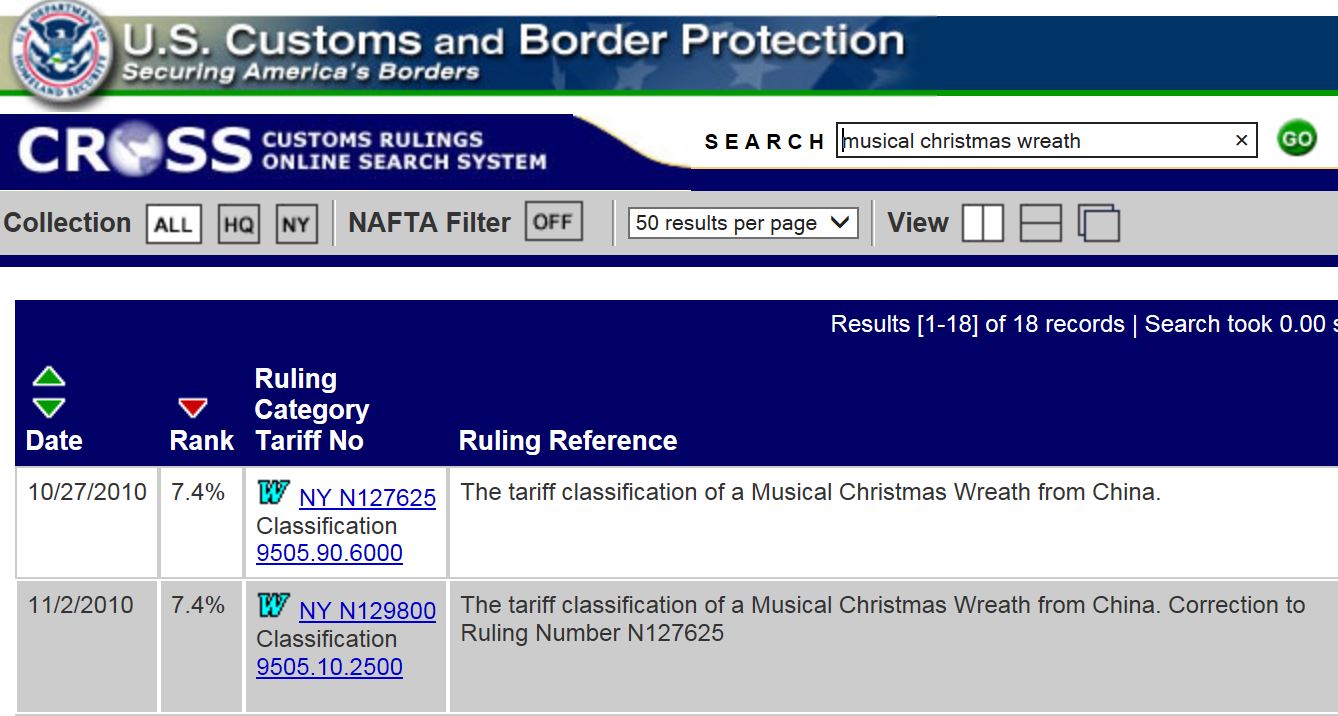
For example, let’s say you’re searching for a ruling on a musical Christmas wreath. You enter the product name and look at the first thing that pops up:

HTS - Ruling Jumper 01

If you just went by the search results, your classification 9505.90.6000 would end up being incorrect. Diving further into the ruling letter itself, you would find that the ruling actually concluded that the item is classified under 9505.10.2500 instead.

And, by looking further, you can see directly below that CBP issued a correction letter to rectify this mistake. Unless you were specifically looking for it, though, you might overlook it.

Believe it or not, this is more commonplace than you might think. That in no way is meant to disparage the hard-working folks in the National Commodity Specialists Division – it just means that sometimes mistakes do happen (they are human, too).

Looking out over the classification landscape, I can see that many of you out there have experienced this at some point during a classification. You’re now wondering to yourself, “Was I possessed by the spirit of the Ruling Jumper? Does he have a foothold in my classification process even now?”

Perhaps, my dear HTS cadet, perhaps. But there is hope.

The first step to any 12-step HTS recovery program is admitting you have a problem, and then seeking guidance from a higher power… such as the HTS Nerd. Joking aside, there are lots of opportunities to get that additional training you may need – just take that first step, and soon you’ll be rid of the Ruling Jumper and the other six Deadly Classification Sins.

Update from the HTS Nerd

superhero-01

Greetings, HTS Cadets!

It’s been some time since the HTS Nerd has posted anything… I’ve been adapting and acclimating to life in Gotham. But fear not! The HTS Nerd will soon be back with new adventures in classification!

I’ve recently partnered with ComplianceOnline to bring a series of classification webinars to the community. Stay tuned for upcoming dates and topics in the near future.

Happy classifying!

Calling All HTS Cadets!

the_propagandaHTS Nerd here… calling out to all of HTS cadets for your help!

I am putting together a plan for my 2016 classification training webinars (once or twice a month), but I want to be sure that my courses have relevance and meaning to the trade community.

The most recent webinars tackled the classifications of semiconductors (October) and tooling (November), and now I need new topics. On the agenda so far, I have:

  • Upcoming 2017 HS changes from the WCO
  • Classification of Cables
  • Parts versus Accessories
  • Understanding the GRIs
  • What constitutes a part of general use
  • Classification of Sets

A good start, but certainly not enough to fill up an entire year!

So… what are some of the areas of the HTSUS that give you the greatest challenge? Is there an area of the HTSUS you feel the trade community could benefit the most from? Share your thoughts with me. Post your message here, or send an email to me at HTSNerd@gmail.com.


Random Question – Update

A few days ago, I posed a question:

When it comes to HTS classification, what additional training or education would the international trade community most benefit from?

It’s a question that’s been on my mind a lot lately as I prepare to step into a new role. I’ve wondered…

  • Is there an area of classification that is lacking guidance or direction?
  • Is there a topic that doesn’t receive enough education?
  • Is there a section or chapter of the HTS that has been overlooked but screams out for attention?
  • Are there areas where the international trade community could simply use a refresher?

Personally, I love a good classification puzzle… there’s nothing like the exhilaration of finding that one specific detail that pulls the entire picture into focus (and that is, in part, why yours truly is a classification nerd). Having spent the last four years of my career classifying aerospace technology that often was not even out of the research and development stage, I’ve certainly had my share of those moments!

Although not a complete shock, the answers I received on LinkedIn, Twitter, email, instant messaging and other forums surprised me a little. I expected more diversity and complexity in how others would reply. Instead, one common thread ran through every message:

Let’s get back to the basics.

It turns out what people in this industry want most, be it for themselves or for the community in general, is a focus on the fundamentals of classification. And in retrospect, it actually does make sense.

I recently had the honor of participating in an educational conference panel discussion on the topic of classification. I asked the audience how many of them determine classifications for their company, and about half of the room raised their hands. I then asked how many of them read the chapter and section notes every time they are determining a classification. Only a few remained up as I watched most of the hands drop.

To those who had their hands still raised, I said that I applaud them for doing so. To those who dropped their hands, I asked them to share their secrets of memorization because the only reason I could think of that someone would not do so is simply they must have those portions of the HTS completely committed to memory. Otherwise, how could they be sure they accounted for all possible inclusions, exclusions, notes, definitions or instructions pertaining to the items classified therein?

In the weeks and months ahead, I’ll be doing a deep dive into the basics of classification and sharing some tips and tricks along the way. And if there is a specific area where I can help you or your company, reach out – I am sure that the team I am joining later this month has a solution for you!

Random Question

What area of HTS classification training and education do you think the international trade community would benefit the most from?

Having worked in a number of industries, my answer would always be based on learning more about the commodities I was classifying. As my own experience has evolved, I actually think a deep dive into the basics is what the industry needs most.

Share your thoughts or experience – I’d really like to know!

Hello, World!

It’s time for the HTS Nerd to step out into the world.

I’ve been so focused on tariff classification the past 12 years within my own organizations that it didn’t occur to me until recently to hit the pause button in order to share some of the tips and tricks I have learned during this journey.

And so, I decided to write this blog so that if someone else can pick up even one thing, one tip or one trick to make their classification lives easier as we continue to move into an environment of increasing compliance and oversight, then I consider it a win.

If you have something the share or add to the conversation, then by all means – I welcome your comments. If you have a question, ask away and I will try to help or advise where I am able. If you come across something you like, tell me (and tell me if you don’t like something as well).