
 International travel is not always about seeing the sites or trying the local cuisine, especially for a classification superhero. Sometimes, a nefarious foe will rear its head and you’ll find yourself battling for the mind of an HTS cadet.
I began the HTS Boot Camp with my new cadets in pretty much the same manner I usually do – by going back to the very basics. I have to make sure that my students have a good working knowledge of the most basic HTS fundamentals. We go over what it is, how it was developed, the structure of the HTSUS, and then start an intensive deep dive into the General Rules of Interpretation.
As my class of global HTS cadets discussed the resources available to help in determining a classification, one cadet said, “I just go to CROSS and use the part name to look for a ruling. I go with the first one I find at the top of the list.”
Although in the guise of this new cadet, I immediately recognized my old foe – the Ruling Jumper. As one of the 7 Deadly Classification Sins, the Ruling Jumper is a spirit that searches out for desperate cadet classifiers who are most susceptible to possession, usually when they find themselves struggling with a particularly difficult determination. It’s in that moment of frustration the Ruling Jumper can get in. He becomes that quiet voice in your mind whispering, “Just go to CROSS… just go to CROOOOOSSSSSSSS…” Before you know it, you’re disregarding all of your training and instead quickly scanning for the first ruling that might have some bearing.
Preying on a cadet’s eagerness to get a hard product classification out of the way and move on to the next, the Ruling Jumper guides the cadet’s fingers to the keyboard and types the most basic part name possible in CROSS to get the most results at once. Which is rather irrelevant because the Ruling Jumper just goes to the first listing that pops up and uses that HTS.
This isn’t my only time I’ve faced off against the Ruling Jumper. I admit – before that fateful paper cut from a radioactive HTSUS that transformed me into a classification superhero, I once fell prey to the Ruling Jumper. Fortunately, I’ve developed a tool that always weakens his hold – education. I know if I successfully educate this young cadet to sharpen his classification skills, the Ruling Jumper no longer has a foothold, and is forced to flee in search of a new host.
The list of reasons one should not jump to the rulings in CROSS are numerous, so let me share the top 3:
Number 1: They do not provide a complete picture.
The requesting company may not have included all of the details… perhaps even leaving something out intentionally in order to obtain a more favorable ruling.
In comparing someone else’s ruling to your product, you often have to make assumptions. There may be additional details that the CBP commodity specialist may not have included, so always keep in mind that the absence of detail in a binding ruling does not mean the detail does not exist.
Number 2: Rulings often change.
Upon further review, Customs may re-determine their classification in a ruling, usually in the form of an HQ ruling. And unless you are the requesting party, you won’t receive direct notification of an update.
Additionally, if you are not frequently following up on every ruling that you reference in your classification’s reasonable care documentation, chances are that at some point you’ll miss an update.
Number 3: Rulings themselves may contain errors.
Believe it or not, you may come across a ruling in CROSS that contains some kind of error.
For example, let’s say you’re searching for a ruling on a musical Christmas wreath. You enter the product name and look at the first thing that pops up:
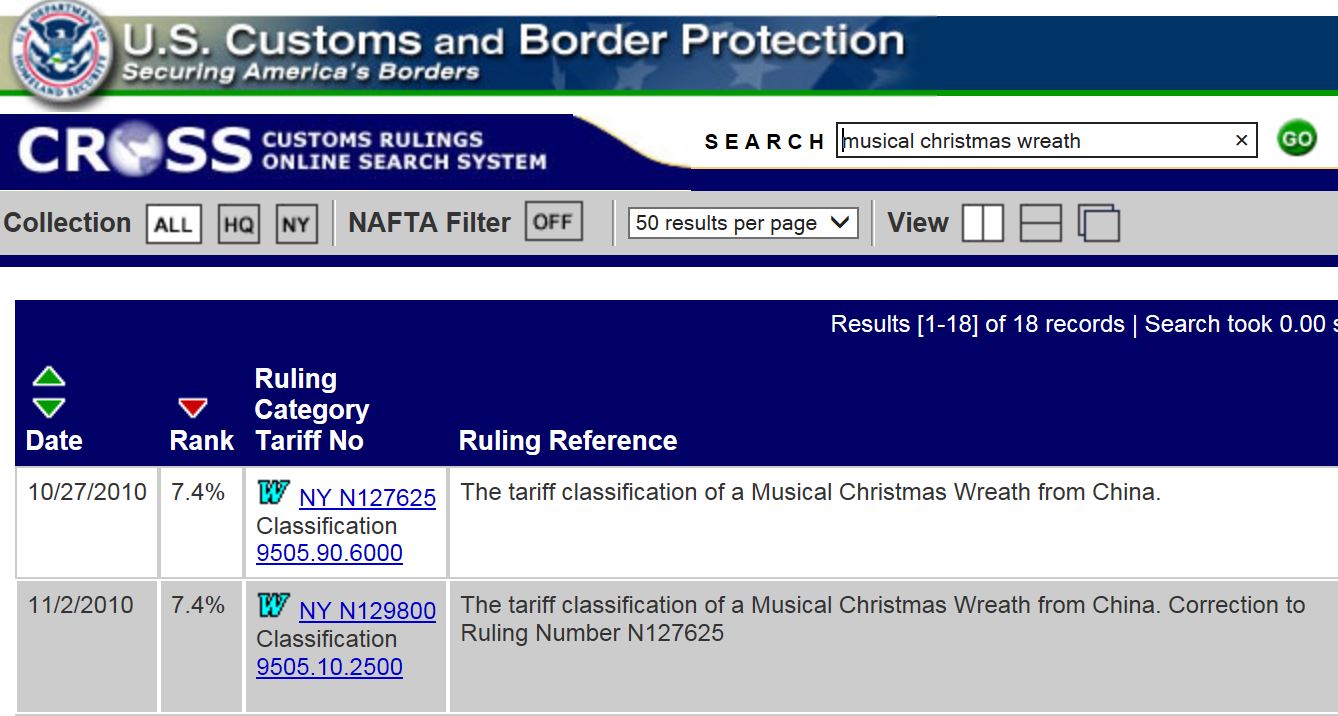
If you just went by the search results, your classification 9505.90.6000 would end up being incorrect. Diving further into the ruling letter itself, you would find that the ruling actually concluded that the item is classified under 9505.10.2500 instead.
And, by looking further, you can see directly below that CBP issued a correction letter to rectify this mistake. Unless you were specifically looking for it, though, you might overlook it.
Believe it or not, this is more commonplace than you might think. That in no way is meant to disparage the hard-working folks in the National Commodity Specialists Division – it just means that sometimes mistakes do happen (they are human, too).
Looking out over the classification landscape, I can see that many of you out there have experienced this at some point during a classification. You’re now wondering to yourself, “Was I possessed by the spirit of the Ruling Jumper? Does he have a foothold in my classification process even now?”
Perhaps, my dear HTS cadet, perhaps. But there is hope.
The first step to any 12-step HTS recovery program is admitting you have a problem, and then seeking guidance from a higher power… such as the HTS Nerd. Joking aside, there are lots of opportunities to get that additional training you may need – just take that first step, and soon you’ll be rid of the Ruling Jumper and the other six Deadly Classification Sins.
 HTS Nerd here, sitting in Terminal 4 at JFK (yes, even classification superheroes have to sometimes travel by normal means), about to jet off to Bengaluru to lead an eager group of HTS cadets in an intense 5-day Customs classification course (try saying that 5-times fast!).
 The HTS Nerd